
Resources.

Routt County Resources
Greenhouse Gas Analysis
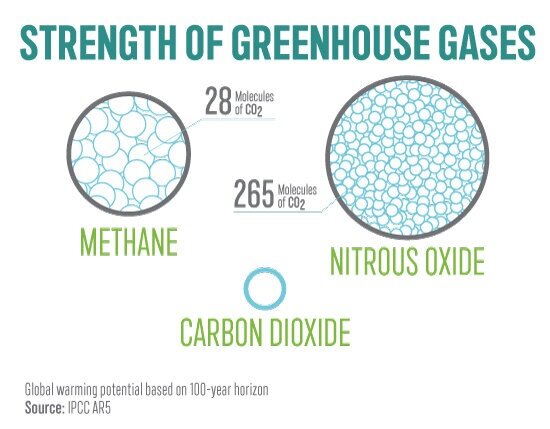
There is broad scientific consensus that significantly reducing our greenhouse gas emissions in the coming years will be essential to avoiding massive impacts from climate change. Global warming occurs when greenhouse gas (GHG) emissions are released into Earth’s atmosphere and absorb infrared radiation from the sun and trap it in our atmosphere – a phenomenon referred to as the ‘greenhouse effect’. There are a number of greenhouse gases that contribute to climate change, including carbon dioxide, methane, nitrous oxide, and several more. To understand the full impact of each gas, emissions are usually accounted for in metric tons of CO2 equivalent (mt CO2e), where each gas is assigned a global warming potential in units compared to one unit of CO2.
Routt County 2023 Greenhouse Gas Emissions Inventory
The Routt County 2023 Greenhouse Gas Emissions Inventory tracks how greenhouse gas emissions have changed since the last greenhouse gas (GHG) inventory was performed in 2018. The inventory was performed in accordance with the Routt County Climate Action Plan accountability recommendation to update the inventory every five years in order to track progress and revise benchmarks as needed.
The results of the inventory show an overall 6% decrease in emissions, decreasing to 669,794 metric tons in 2023 from approximately 713,392 metric tons in 2018. This overall decrease in emissions is attributed to the reductions in emissions associated with electricity use combined with the “greening of the grid” trends in the energy sector, or the replacement of fossil fuel-generated electricity with renewable energy-generated electricity.
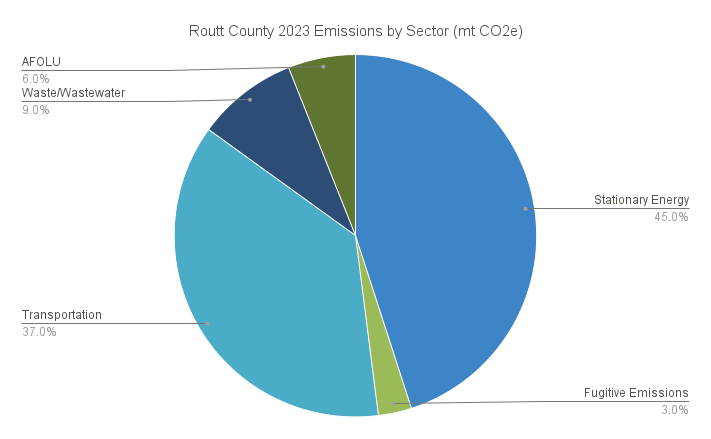
Stationary energy sector emissions from commercial and residential buildings continue to comprise the largest source of Routt County’s GHG emissions at 45%, or 304,014 mt CO2e. Stationary energy emissions include emissions from electricity, natural gas, and propane used in buildings as well as diesel used in generators. Due to the greening of the grid, there was a 26% decrease in emissions in this sector from the 2018 data, which contributed to the overall reduction of emissions in the county-wide inventory. Of note, electricity use dropped by 5% from 2018 to 2023, highlighting a shortfall in the progress of building electrification. This emission trend highlights the need for Routt County, City of Steamboat Springs and Towns of Hayden, Oak Creek and Yampa to pursue beneficial electrification for new and existing buildings.
The transportation sector was the second largest source of emissions at 37%, or 249,126 metric tons overall. This is a 32% increase in transportation emissions from the 2018 data, and of note, driven by an increase of 26% in Vehicle Miles Traveled (VMT). VMT refers to the emissions generated by driving cars and trucks. This increase in transportation emissions combined with the increase in VMT highlight the importance of advancing transportation solutions that support and incentivize alternative transportation options, such as public transportation and electric vehicles.
The third largest sector of emissions is waste at 9% of total emission or 61,408 metric tons, which showed a 10.5% increase in emissions from the 2018 data. The primary source of waste emissions comes from the release of methane, which occurs when materials decompose in the landfill. The increase in waste emissions underlines the importance of continuing to develop initiatives that increase and support recycling, composting and waste reduction.
Fugitive emissions (leakage of natural gas, oil and gas wells, and active coal mines) comprised 3% of Routt County’s emissions. The remaining emissions came from the agriculture, forestry, and other land use (AFOLU) sector, with 6% of overall emissions for Routt County. The largest AFOLU sources of emissions are methane emissions from livestock.
Since the Routt County Climate Action Plan (CAP) was adopted in 2021, the 2023 inventory provides an important, but partial snapshot of actions that have been taken thus far – or are planned – to reduce emissions according to CAP recommendations. Key actions like the updates to development codes, installation of solar panels, electrification of buildings, public transportation improvements and more have made strides in reducing emissions and/or avoiding significant increases in emissions. Some successes reflected in the inventory include a 600% increase in local solar panels and a 6% increase in public transit ridership.
Periodic GHG inventories, such as this one, are an important tool to inform how well Routt County and Steamboat Springs’ climate change initiatives are working and can help inform where the City and County should focus future efforts in our shared goal to support a vibrant, healthy, carbon-free community.
Routt County 2018 Greenhouse Gas Emissions Inventory
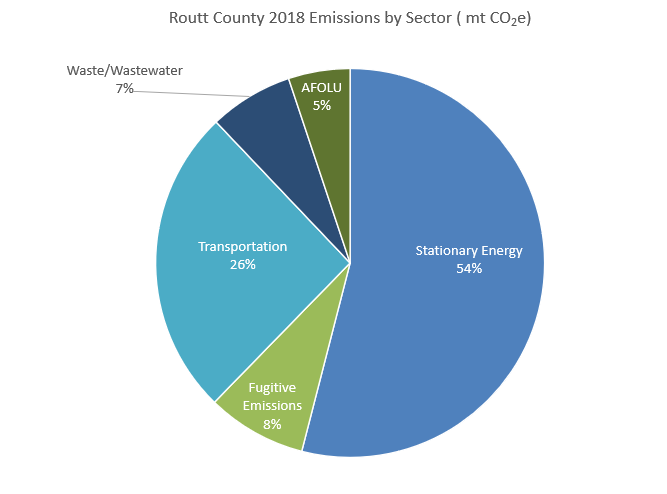
The 2018 Greenhouse Gas Emissions Inventory showed Routt County emissions, including the City of Steamboat Springs, totaling 693,367 mt CO2e. That’s the same amount of emissions as 150,000 passenger cars driven for a year! Stationary energy sector emissions from commercial and residential buildings comprise the largest source of greenhouse gas emissions within Routt County (54%) followed by transportation (26% in Routt County). Stationary energy emissions include emissions from electricity, natural gas, and propane used in buildings as well as diesel used in generators. Fugitive emissions (includes leakage of natural gas, oil and gas wells, and active coal mines) comprised eight percent of Routt County’s emissions, followed by waste and wastewater emissions at seven percent. The remaining emissions came from the agriculture, forestry, and other land use (AFOLU) sector, with five percent of overall emissions for Routt County. The largest AFOLU sources of emissions are methane emissions from livestock as well as biomass burning (i.e., wildfires).
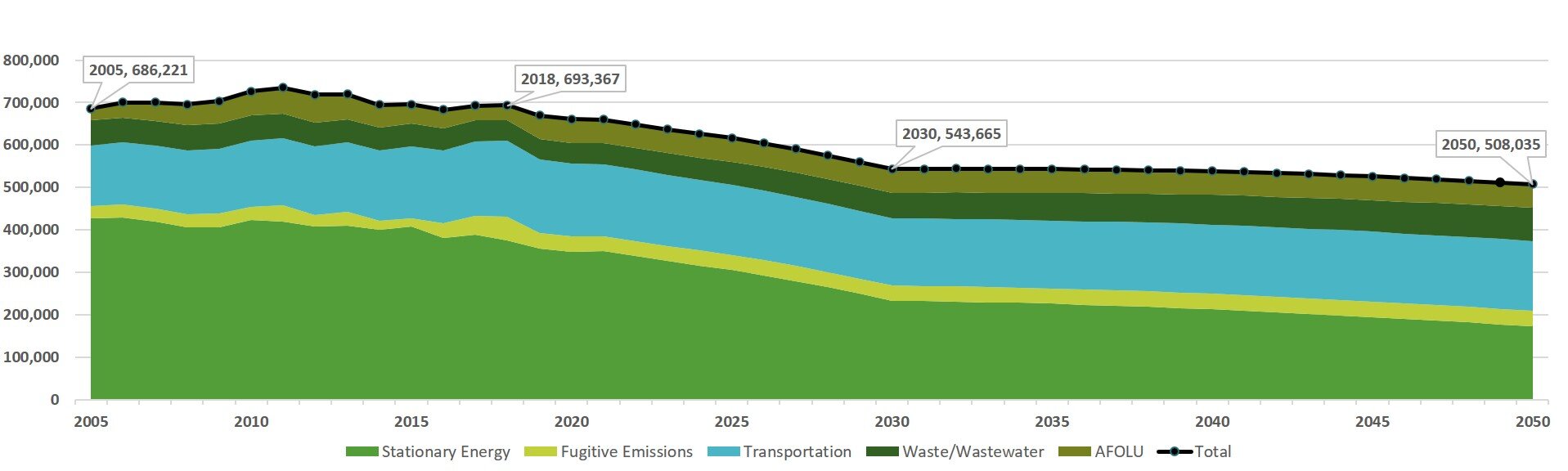
Without any actions taken to mitigate climate change, it is projected that Routt County will decrease emissions by 26% by 2050 from the baseline year of 2005. The sector that contributes the most to this decrease is the stationary energy sector; this is largely driven by utility commitments to increase the amount of renewable energy in the electricity supplied to the community. As emissions from the stationary energy sector decrease with the greening of the grid (i.e., more renewable energy), the transportation sector becomes the largest source of emissions for Routt County by 2050.